From your desk lamp to your hot tub to your car charger, electricity is everywhere in your home. So, naturally, when there’s an outage, it’s going to be inconvenient. But the real question here is why that happens in the first place. Plenty of times, the reason why a few outlets and lights stop working is due to an overloaded circuit; at other times, it’s a thunderstorm. You can try to find the cause of the disruption by isolating the faulty circuit, but contacting an electrician is best. If you’re wondering about the reasons behind electrical outages, you’ve just found the perfect blog.
From Bright To Black: Common Causes Of Residential Power Outages
Did your hair dryer stop working as you were diffusing your hair? Or did you get thrown into blackness as you were walking down the stairs? It looks like there’s a power outage in your home. Your property is equipped with various devices such as AFCIs and circuit breakers that cut power during an emergency. This section explores the most common reasons of power outages.
Take note as we list them all.
-
Circuit Overloads
A circuit overload happens when you have too many heavy-duty appliances like the toaster, food processor, and oven connected to a single circuit. The breaker trips to keep your wiring from melting.
-
Faulty Appliances
Maybe your circuit isn’t overwhelmed, but you have an old appliance or two. If your appliances have frayed wiring, damaged motors, or other internal issues, they’ll trigger the breaker and cause a power outage too.
-
Thunderstorms
The source of your internal home electrical problems doesn’t have to be inside the house. A particularly strong storm can knock down external wiring or even shut off the grid in extreme situations—thus leaving you in the dark.
-
GFCI Trips
Another reason behind an unexpected power outage is when electricity comes into contact with a grounded metal path or water. The ground fault circuit interrupter activates to prevent electrocutions.
-
Frayed Wiring
If your building is old, the cables running through your walls are probably not in their prime. If the wiring is frayed, bent, exposed, or broken, it won’t provide a steady connection, and the power can go out.
-
Phase Loss
What if the power outage is partial, though? If only part of your home is receiving power while the other half is in complete darkness, it might be a failed phase. This could either be an internal issue or a fault in the utility line.
Electrical Troubleshooting: What To Do During An Outage
Still with us? Awesome! Now that you have a better understanding of all the reasons behind power outages in your home, you might be wondering if there’s anything you can do to fix them. Though you do need an expert residential electrician to resolve complex electrical problems, you can try a few simple things too. From looking out the window to flipping the breaker, here is how to troubleshoot an electrical outage.
Continue reading as we explain.
-
Assess The Scale
When the power goes out, you need to determine how much of the house is affected. Try turning on other outlets and lights. If that fails, look out the window to check the state of the neighborhood.
-
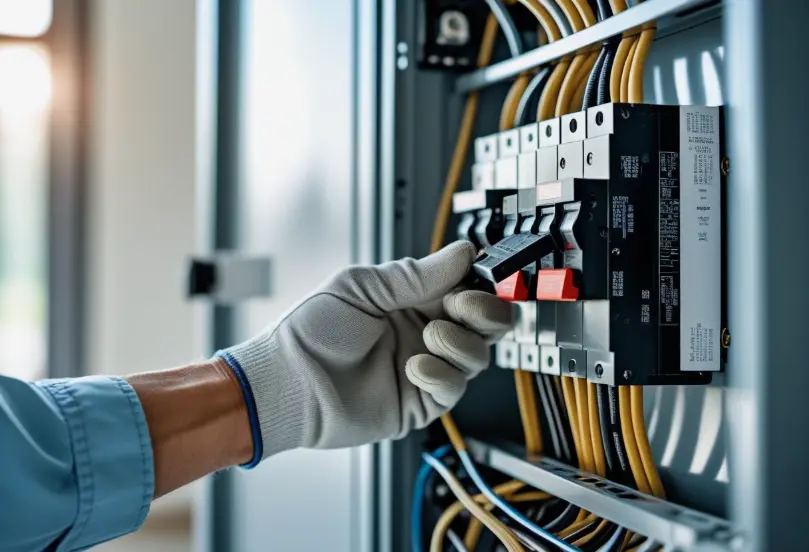
Inspect the electric panel
If the issue seems to be at your end alone, go ahead and look for a tripped circuit breaker. The one at fault should be in the middle position between ‘off’ and ‘on.’
-
Unplug Appliances
Before flipping the correct breaker, make sure to disconnect all delicate devices like phone chargers and laptops, and also disconnect the refrigerators, ACs, and microwaves.
-
Reset Breakers
If more than one breaker is behind the electrical system failure, flip only one of them to the ‘off’ position, wait a few seconds, and then flick it on. Repeat till you find the faulty breaker.
-
Find The Faulty Device
If one of the breakers flips off as soon as you turn it on, that’s your culprit. Methodically reconnect each of the devices and lights dependent on that specific breaker. When it trips, you’ll have found the true cause.
-
Call An Electrician
Finally, reach out to a reliable electrical contractor to check the electrical system and resolve the issue. Don’t try to replace or upgrade anything on your own for safety.
-
Conclusion
In conclusion, there are plenty of reasons why electrical outages happen. It could be an overloaded circuit, an old appliance or even loose wiring behind the electrical system failure. Check if the neighbors have power, then inspect each of your breakers to find the true cause of the outage. Be sure to contact a professional for safety and efficiency. We hope this blog was insightful. If you have more questions, please reach out to us.
-
FAQS
How often should I have my electrical system inspected?
You should schedule a residential electrical inspection every 3-5 years.
How do I prevent an overloaded circuit?
Distribute heavy-duty devices across multiple circuits to prevent overloads.
How long does an electrician take to arrive in a power outage?
An emergency electrician takes about 1-3 hours to reach your location.